The U.S. Army Corps of Engineers (USACE), Charleston District has officially announced the completion of their Grand Strand Renourishment project. The Charleston District awarded a construction contract to Great Lakes Dredge and Dock Company from Houston in December 2024, to renourish nearly 28 miles of the Grand Strand at a cost of $72 million funded entirely by USACE.
According to the Corps, this project was critical for strengthening coastal storm protection for the region and helping to preserve the region’s infrastructure and $12.5 billion tourism-driven economy.
“The primary purpose of the renourishment is to build a wider, higher beach and dune system that can absorb storm wave energy and reduce coastal storm risk. A robust beach and dune system helps protect oceanfront infrastructure such as roads and utilities from flooding and structural damage. While the renourished beach provides an inviting shoreline for residents and visitors, coastal protection remains the primary goal of the federal project,” USACE officials announced.
Beachcombing for Treasures
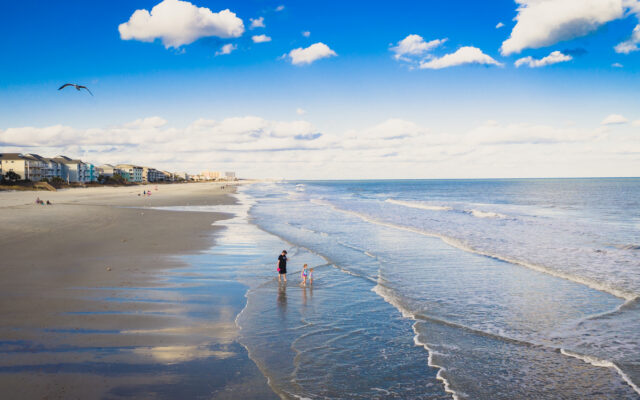
Additionally, the new sand is providing more space for activities and revealing a treasure-trove of coastal gems like seashells and shark teeth. In fact, shark teeth experts say this year’s project was especially bountiful, producing an abundance of shark teeth that had previously been buried beneath the seafloor as well as larger fossils, even Megalodon teeth.
Try these tips for finding shark teeth like the pros:
- Search the Shell Line: Scan slowly where shells accumulate. Shark teeth are heavier than sand and often collect in these natural collection areas.
- Go After High Tide or Early Morning: The best time to search is after high tide recedes or early in the morning before the beach becomes busy.
- Keep an Eye Out for Dark Triangles: Most fossilized shark teeth found along the Grand Strand are black, dark gray or brown and have a distinctive triangular shape.
Safety Pointers for Explorers
Freshly renourished beaches can be exciting places to explore, but conditions may look and feel different while the shoreline naturally settles.
- Watch your step. Newly placed sand can contain shells, broken shell fragments and other material dredged along with the sand. Consider wearing beach shoes when exploring.
- Be careful around sand drop-offs. Renourishment can temporarily create steep ridges or small sand “cliffs,” known as escarpments. Don’t climb or dig into them, and keep children away from steep edges. These formations typically change as waves and tides reshape the beach.
- Look, don’t dig aggressively. Shark teeth, shells and other finds may be visible on or near the surface. Avoid digging deep holes, particularly into newly formed slopes. Replace all holes after use.
- Report anything truly unusual. An interesting shell or shark tooth can become a beachcombing souvenir, but potentially significant artifacts or suspected shipwreck material shouldn’t become one. While significant archaeological finds are rare, they should be reported.
More About The Project
The district restored the federally authorized storm damage reduction project along North Myrtle Beach, Myrtle Beach, Surfside Beach and Garden City after significant erosion from recent storms.
Over the course of construction, crews placed more than 1.55 million cubic yards of sand to renourish nearly 28 miles of coastline. This massive effort included:
- North Myrtle Beach: Nearly 675,000 cubic yards across 8.29 miles.
- Surfside Beach & Garden City: Over 600,000 cubic yards along 7.7 miles.
- Myrtle Beach: 275,000 cubic yards across 11.94 miles.
You would need around 155,000 10-yard dump trucks to move the same amount of sand. Bumper-to-bumper, the line would stretch around 820 miles or the distance from Charleston, South Carolina, to New York City.
According to the Corps, the Grand Strand Renourishment project progressed steadily down the coast this year. North Myrtle Beach sand placement finished Jan. 31. In Myrtle Beach, work began in May and sand placement finished July 3. Surfside Beach and Garden City construction began July 3, and finished in early August, which marked completion of the final phase of the project.
Hurricane Ian struck the South Carolina coast in September 2022, and Hurricane Debby in August 2024. Both storms caused severe erosion to the Grand Strand beaches. The engineered beach performed as designed and helped reduce infrastructure damage. Following the storms, USACE determined that emergency renourishment was necessary to restore the level of storm protection that the project provided.
The Charleston District will continue to monitor the Grand Strand project in coordination with its partners and remains committed to supporting coastal storm risk management and resilience along the South Carolina coast.